
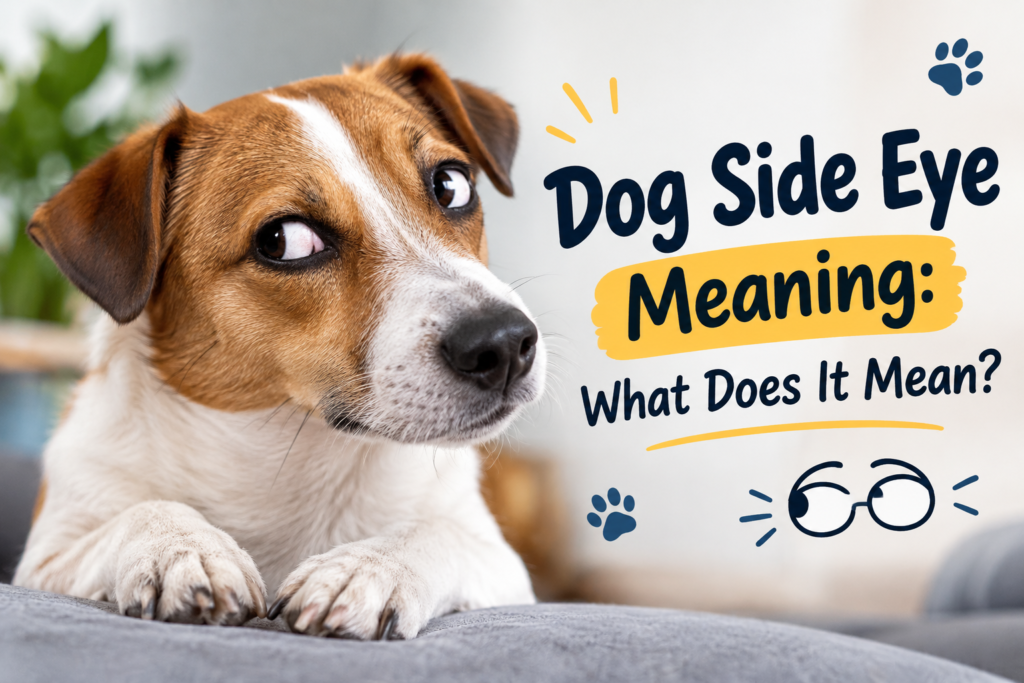
You’re sitting on the couch, and suddenly you notice it: your dog is staring at you out of the corner of their eyes, head slightly turned, with a bit of white showing. It looks funny, a little dramatic, and sometimes even judgmental. Many dog owners find this look both adorable and confusing. At NameGalaxi, we love exploring the little quirks that make our furry friends so special.
This behavior is commonly known as “whale eye,” and it is a form of canine body language. Dogs can’t tell us how they feel with words, so they rely on posture, ears, tails, and eyes to communicate. Side eye can mean different things depending on the situation. Sometimes it signals curiosity or guarding a favorite toy, while other times it may show that your dog feels uneasy or stressed.
Understanding the reason behind that sideways glance helps you respond in the right way and strengthens the bond with your pet. In this guide from NameGalaxi, we’ll break down the most common causes, from playfulness to discomfort, and show you how to read the rest of your dog’s signals. Once you know what to look for, you’ll never see that side eye the same way again.
What Does Dog Side Eye Mean?
Dog Side Eye Meaning in Simple Words
Dog side eye is when a dog turns its eyes toward something while keeping its head pointed in a different direction. Instead of facing you straight on, your dog looks at you out of the corner of its eye. Sometimes the head turns slightly away, and sometimes the whole body angles off to one side.
In plain terms, the dog is watching something without fully committing to it. That “something” could be you, another animal, a piece of food, or an object that has caught its attention. The meaning depends heavily on everything else the dog’s body is doing at that moment.
What Does It Mean When a Dog Looks at You Sideways?
When a dog looks at you sideways, it is usually gathering information. Dogs read the world through movement, posture, and tone, and a sideways glance lets them keep tabs on you without a full-on stare.
Direct, head-on eye contact can feel intense in dog language. Among dogs, a hard stare can come across as a challenge. A sideways look is softer and less confrontational. It can mean “I see you, and I’m not looking for trouble,” or it can mean “I’m not sure about this, so I’m keeping an eye on you.”
Context is everything here. A loose, wiggly dog glancing at you while you hold a treat is in a very different emotional place than a stiff, frozen dog glancing at you while you reach for its bone.
Why Is Dog Side Eye So Popular?
Part of the popularity is that it looks so human. We recognize the sideways glance from our own lives: the skeptical look, the “did you really just say that?” look, the silent judgment across a dinner table. When a dog does it, we instantly project that familiar meaning onto the animal.
The other part is that dogs tend to do it at funny moments. They give you the look when you sing off-key, when you put on a ridiculous outfit, or when you announce that no, they cannot have any more cheese. Pet owners film these moments, share them, and the expression becomes an internet favorite.
What Does Dog Side Eye Mean in Different Situations?
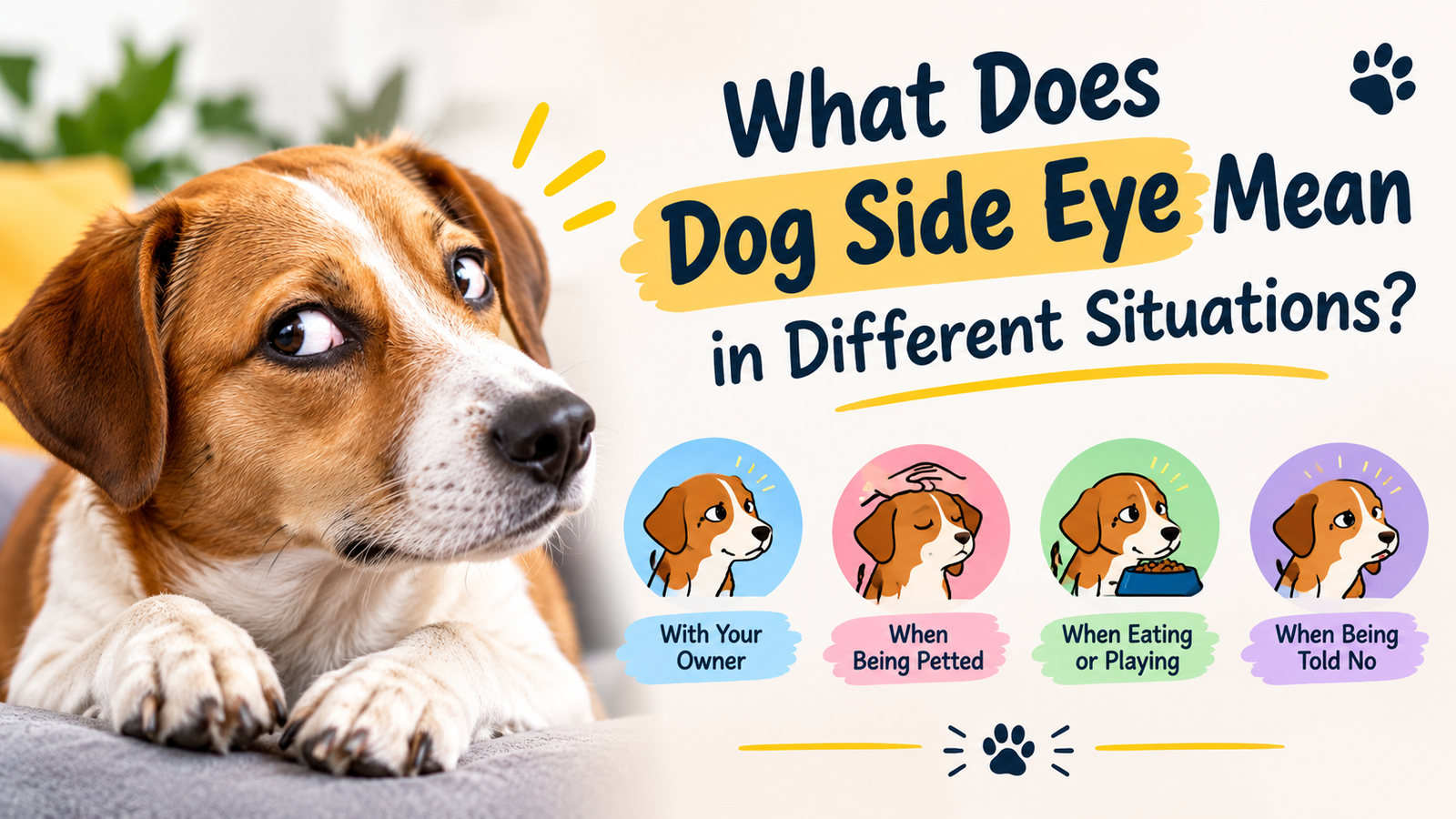
Dog Side Eye When Looking at Its Owner
When a dog gives you the side eye at home, it is often checking in. Dogs are tuned in to their people and watch us constantly for cues about what happens next: Is a walk coming? Is dinner coming? Is something wrong?
A relaxed dog with soft eyes and a loose body that glances at you sideways is typically just keeping you in its field of view. It can also be a mild form of waiting, as in “I’m hoping you’ll notice me, but I’m not going to push.”
If your dog does it while you’re eating, it’s almost certainly about the food. Dogs learn quickly that humans sometimes drop things, and a sidelong glance is the polite way of staying close to the action.
Dog Side Eye When Being Petted
Petting is a place where side eye deserves attention. Some dogs love physical contact and show it with a relaxed face and leaning body. Others tolerate it, and a sideways glance may be the first hint that they’ve had enough.
If your dog glances at your hand while you pet it, and its body is stiff, its mouth is closed tight, or it turns its head away, it may be uncomfortable. This is especially common when someone pets a dog on the top of the head, hugs it, or leans over it, all of which many dogs find invasive.
A happy dog usually leans in, softens its eyes, or nudges your hand for more. A dog that looks at your hand sideways and holds very still is asking you to ease off.
Dog Side Eye When Eating or Playing
During meals, side eye often points to a dog protecting its food. If your dog freezes over its bowl or a chew and tracks you with a sideways glance, it may be worried you’ll take it. This is called resource guarding, and it’s worth taking seriously, since it can escalate to growling or snapping if the warning signs are ignored.
During play, the story changes. Dogs often glance sideways at their playmates as part of normal play, checking in, sizing up the next move, or inviting the other dog to chase. In this case the body is loose and bouncy, the mouth is relaxed, and the movements are exaggerated and wiggly.
Dog Side Eye When Being Told No
When you tell a dog no, you might get a look that seems like pure attitude. Often what you’re seeing is a dog reading your tone and trying to work out what happened. Dogs are very good at picking up on the emotion in a human voice even if they don’t understand the words.
The sideways glance may be a way of reducing tension. Averting the head while still watching you can be a calming signal, a small gesture dogs use to say “I’m not a threat, let’s keep things calm.” So the so-called sassy look may actually be a polite attempt to smooth things over.
Dog Side Eye Meaning in Body Language
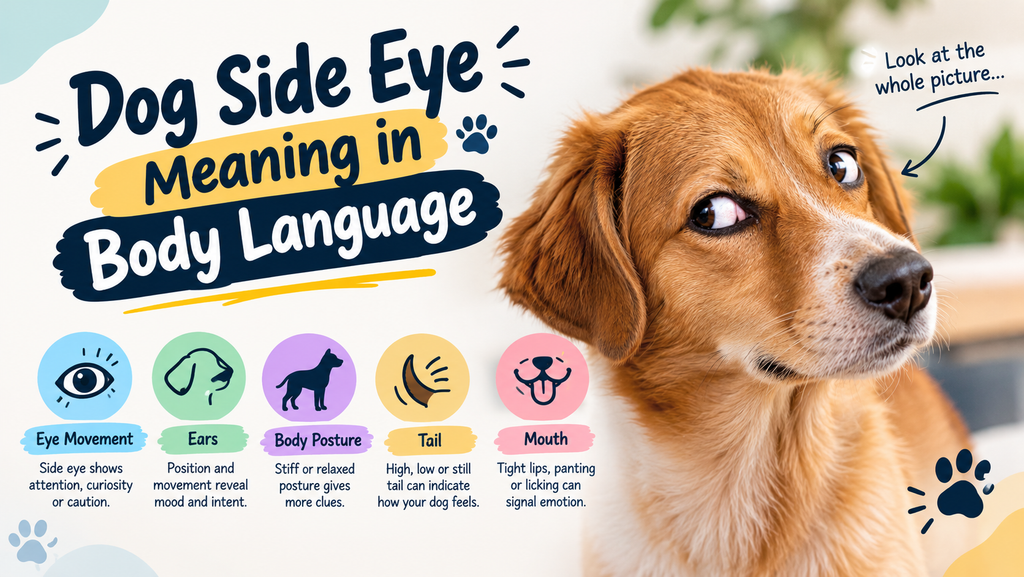
A dog’s eyes never work alone. To understand what a sideways glance means, read the whole animal: ears, mouth, tail, posture, and muscle tension all add up to the real message.
Dog Side Eye as a Sign of Curiosity
A curious dog with side eye usually looks interested rather than tense. The ears may be forward or slightly tilted, the head might cock to one side, and the body stays loose. The dog is simply processing something new, like an odd sound, an unfamiliar person, or a strange object in the yard.
Curiosity-based side eye tends to be brief. The dog glances, investigates, and then either approaches or loses interest.
Dog Side Eye as a Sign of Discomfort
Discomfort looks a bit different. The dog holds the glance longer, the body goes stiff, and the face tightens. You might see a closed mouth, a clenched jaw, or a head turned away while the eyes stay fixed on whatever’s bothering the dog.
Other signs that often come with it include lip licking, yawning when the dog isn’t tired, and a lowered body. These are all small ways dogs say “I’m not comfortable right now.”
Dog Side Eye as a Sign of Fear or Anxiety
When fear is in the mix, the sideways look becomes more pronounced. The dog may show the whites of its eyes, tuck its tail, flatten its ears against its head, or crouch low. It might try to move away while still watching the thing that scares it.
A frightened dog uses side eye because it doesn’t want to turn its back on a perceived threat but also doesn’t want to escalate by staring directly. If you see this, give the dog space and avoid forcing interaction. A dog that feels cornered may react defensively.
Dog Side Eye as a Sign of Relaxation or Alertness
Side eye isn’t always about stress. A sleepy dog lounging on the sofa may give you a lazy sideways look from half-closed eyes, which is just a calm check on what’s going on. The body is soft, the breathing slow, and the face smooth.
On the other end, an alert dog may use side eye while on watch. Think of a dog sitting by the window, head angled, eyes tracking a squirrel or a passing car. Here the posture is attentive but not tense, and the dog is monitoring rather than reacting.
Dog Side Eye vs. Whale Eye: Meaning and Differences
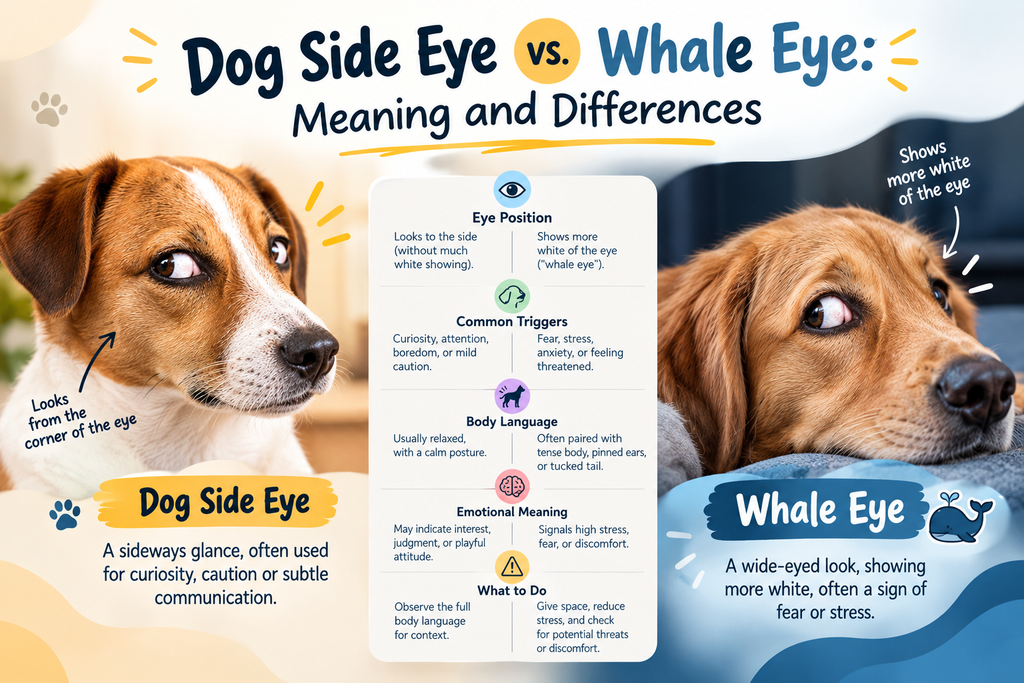
People often use these two terms interchangeably, but they aren’t the same thing, and the difference matters.
What Does Whale Eye Mean in Dogs?
Whale eye, sometimes called half-moon eye, happens when a dog turns its head away but keeps its eyes locked on something, so that a crescent of white shows around the eyeball. It’s most visible on dogs with darker eyes, where the white contrast stands out.
Whale eye is widely recognized by trainers and behaviorists as a sign of stress. It often shows up when a dog feels threatened, guarded, or pushed beyond its comfort zone. Common triggers include being hugged, having a toy or bone approached, or being cornered by a stranger.
How to Tell Dog Side Eye Apart From Whale Eye
The easiest clue is the white of the eye. In ordinary side eye, the dog is simply looking sideways, and you may see little or no extra white. In whale eye, a distinct crescent of white appears because the eyes are strained to the side while the head stays still or turns away.
Whale eye also tends to look tense. The dog may freeze, hold its breath, close its mouth, and stiffen its whole body. Regular side eye, in contrast, is often fleeting and attached to a relaxed body.
Put simply, side eye is a direction of gaze, while whale eye is a stress signal. All whale eye involves a sideways look, but not every sideways look is whale eye.
What a Dog’s Eyes and Body Language Can Tell You
The eyes are just one piece of the puzzle. To read your dog accurately, look at the cluster of signals together:
A relaxed dog has soft, almond-shaped eyes, a loose mouth, a wagging or neutral tail, and a body that moves fluidly. A stressed dog shows hard or wide eyes, visible white, a closed or tight mouth, stiff posture, a tucked or rigid tail, and sometimes panting or lip licking.
If you can only remember one rule, it’s this: look for tension. Loose and wiggly generally means comfortable. Stiff and frozen generally means trouble.
Funny Dog Side Eye Meaning: Why Do Dogs Look Judgmental?
Why Does My Dog Give Me a Sassy Look?
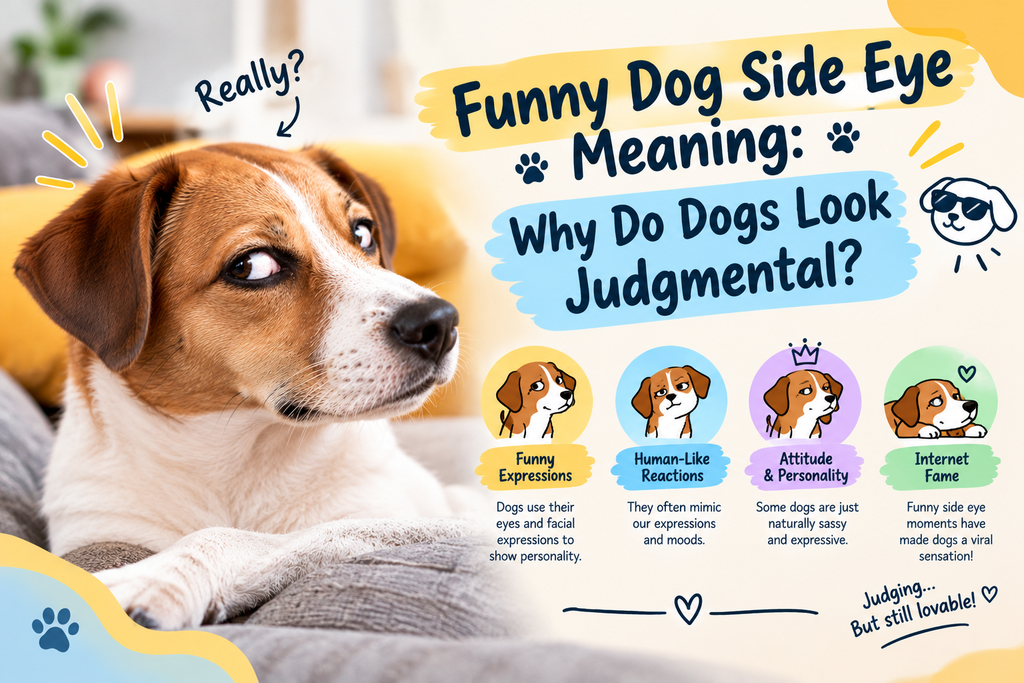
The sassy look is mostly in our heads, and that’s part of the fun. Dogs don’t have sarcasm the way people do. What we read as an eye roll or a raised eyebrow is usually a dog watching, waiting, or assessing the situation.
That said, dogs do have personalities and clear preferences. A dog that stares sideways at you when you’re late with dinner is communicating something real: it wants food, and it’s keeping you in sight until you deliver.
Does Dog Side Eye Mean My Dog Is Annoyed?
Sometimes, yes. A dog can be mildly irritated by a lot of things: being woken from a nap, being dressed up, being interrupted during a favorite activity. A sideways glance in those moments can express “I’m not thrilled about this.”
Still, annoyance in dogs is usually short-lived and low-level. If the glance comes with a stiff body, a growl, or a lifted lip, it has moved past annoyance and into a warning that deserves respect.
Why Do Dogs Give Humans Funny Looks?
Dogs have spent thousands of years living alongside people, and over that time they’ve become unusually skilled at reading human faces and behavior. Many of the faces they pull are learned: they discover that certain expressions get a reaction from us, whether it’s laughter, attention, or a treat.
Our own reactions reinforce it. If you laugh every time your dog gives you the side eye, you may be accidentally teaching it to do so more often. Some of the “funny looks” you see are a collaboration between your dog’s natural expressions and your enthusiastic response.
Is Dog Side Eye a Good or Bad Sign?
When Dog Side Eye Is Completely Normal
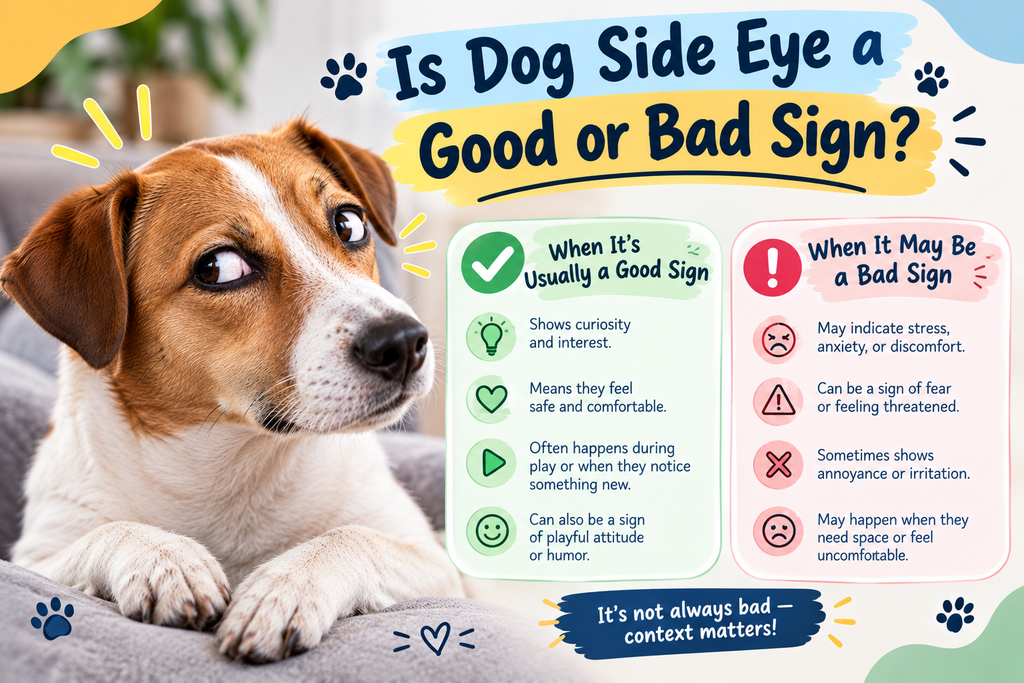
Most of the time, it’s normal. Dogs use their eyes all day to watch, check in, and take in their surroundings. A brief sideways glance during a walk, while you cook, or while the family watches TV is ordinary behavior.
If your dog’s body is relaxed, its movements are fluid, and the look passes quickly, there’s nothing to worry about. It’s simply your dog being observant.
When Dog Side Eye May Indicate Stress
The picture changes when the glance comes with tension. Be alert if the side eye appears alongside whale eye, a frozen body, a tightly closed mouth, repeated lip licking, yawning, or a tail held low or stiff. Also pay attention to patterns. If your dog consistently gives you that look in the same situation, such as when someone approaches its food or when it’s picked up, it’s telling you something about that situation.
Signs That Your Dog Needs Space
Dogs rarely go from calm to biting without warning. They usually send a series of signals first, and side eye is often one of the early ones. Signs your dog wants you to back off include:
- Turning the head or body away
- Freezing
- Showing whale eye
- Growling
- Curling the lip
- Stiffening
- Trying to leave the area
If you notice any of these, stop what you’re doing, move back calmly, and let the dog decide when to re-engage. Respecting these early signals helps prevent escalation and builds trust over time.
Dog Side Eye Meaning Across Different Dog Breeds
Why Some Dogs Naturally Have Different Eye Positions
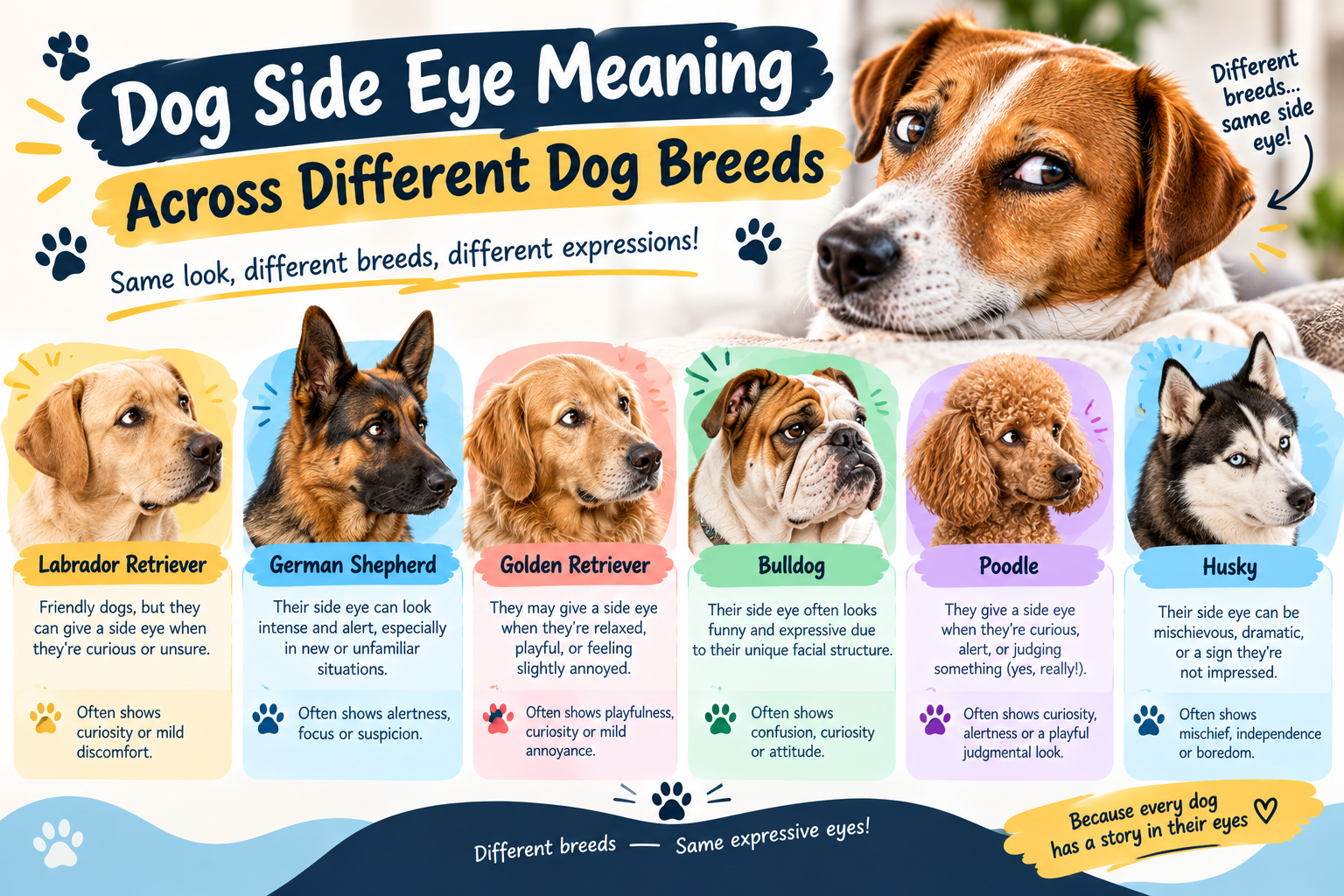
Not every dog’s side eye means the same thing, partly because dog anatomy varies widely. Breeds with eyes set more to the sides of the head, like some sighthounds, naturally have broader peripheral vision and may appear to look sideways more often.
Breeds with prominent or large eyes, such as Pugs, Boston Terriers, and Shih Tzus, can show more white without being stressed at all. Their eye shape makes the white more visible, so it’s easy to mistake a normal look for whale eye.
Border Collies and other herding breeds are known for an intense, focused gaze, which they often use to watch and control movement. That fixed look can come across as strange or unsettling, but it’s rooted in their working instincts.
How Facial Features Affect a Dog’s Expression
Facial structure shapes expression. Dogs with wrinkled foreheads, droopy eyelids, or heavy brows can look permanently disapproving, suspicious, or sad, even when they feel perfectly content. Dark fur around the eyes can hide the eye shape and make signals harder to read, while light-colored eyes tend to highlight the whites.
The takeaway: learn your own dog’s baseline. A Bulldog’s resting face looks very different from a Greyhound’s. Once you know what’s normal for your dog, changes in expression become much easier to spot.
Frequently Asked Questions About Dog Side Eye Meaning
Does Dog Side Eye Mean a Dog Is Mad?
Not necessarily. Side eye can show many feelings, including curiosity, caution, or mild irritation. If the dog also shows stiffness, growling, or bared teeth, it may be upset or feeling threatened. In a relaxed dog, though, a sideways glance is usually just observation.
Does Dog Side Eye Mean a Dog Doesn’t Like You?
No. Side eye is not a measure of affection. A dog that adores you will still glance at you sideways while you eat, pet it, or walk by. What matters more is how your dog behaves overall: whether it seeks you out, relaxes near you, and enjoys your company.
Can Dogs Give Side Eye Out of Jealousy?
Possibly. Research suggests dogs can show jealousy-like behavior when their owners give attention to another dog or even a toy dog. A sideways glance at you and a rival might be part of that. Many experts caution against assuming dogs feel jealousy exactly as humans do, but the behavior is real and often involves a dog trying to regain your attention.
Do Dogs Know They Are Giving Side Eye?
Most likely not in the way we imagine. Dogs aren’t consciously aiming for a particular facial expression. They’re responding to what they feel and what’s around them. The look is instinctive, though dogs can learn that certain behaviors earn a response from us.
Is Dog Side Eye a Sign of Guilt?
Despite the popular “guilty dog” videos, studies suggest that what looks like guilt is actually a reaction to the owner’s body language and tone. A dog that glances sideways, lowers its head, and avoids eye contact after a mess is usually responding to your displeasure, not feeling remorse over what it did.
Should I Be Worried When My Dog Gives Me Side Eye?
Usually not. Occasional side eye is a normal part of dog communication. Pay attention if it comes with tense body language, whale eye, growling, or avoidance, or if it appears suddenly alongside other behavior changes. In those cases, give your dog space, and consider consulting a veterinarian or a certified trainer or behaviorist, since pain and anxiety can both change how a dog acts.
Final Thoughts on Dog Side Eye Meaning
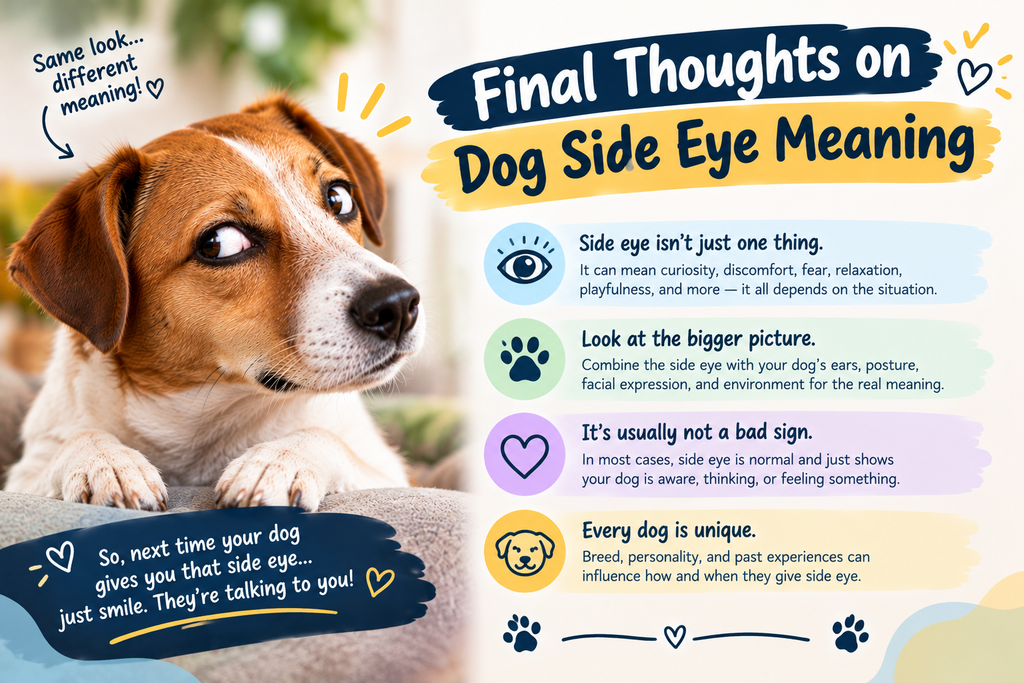
The dog side eye is a tiny expression that carries a lot of information. It can mean curiosity, hope, caution, discomfort, or plain old relaxed observation. The funny, judgmental look we love to share online is often just a dog doing what dogs do best: paying close attention to the people around them.
The key is to read the whole dog, not just the eyes. Notice the ears, the mouth, the tail, and the overall tension in the body. Get to know what your dog’s normal looks like, and you’ll be able to tell the difference between a playful glance and a quiet request for space.
The next time your dog shoots you that sideways stare, take a second to read the message. You might find it’s less sass and more conversation, and responding well to it is one of the simplest ways to build a deeper bond with your best friend. Thanks for reaching NameGalaxi.
