


If you’ve ever filled out a form that asked for your “maiden name” and paused to think about what it actually means, you’re not alone. This term shows up everywhere from bank security questions to wedding planning conversations yet a lot of people only have a vague sense of what it really covers.
In this guide, we’ll break down the exact meaning of a maiden name, how it differs from a married name, why the tradition of name-changing exists, and what your options are if you’re getting married, getting divorced, or just curious about your own family history. By the end, you’ll have a complete, practical understanding of the term and how it applies to real life.
What Does Maiden Name Mean?
A maiden name is the surname a woman is born with or given at birth, before she marries and potentially adopts her spouse’s last name. In simpler terms, it’s a woman’s family name prior to marriage the name that appears on her birth certificate, early school records, and other documents issued before her wedding.
For example, if a woman named Sarah Collins marries a man named James Parker and she chooses to take his last name, she becomes Sarah Parker. In this case, “Collins” is her maiden name.
The term is rooted in the old use of the word “maiden,” meaning an unmarried woman or girl. While the phrase has old-fashioned origins, it’s still widely used today in legal paperwork, genealogy research, casual conversation, and identity verification.
It’s worth noting that a maiden name isn’t automatically the same as a birth name in every case we’ll cover that distinction a little later.
Maiden Name vs. Married Name: What’s the Difference?
The difference between a maiden name and a married name comes down to timing and legal status.
- Maiden name: The surname a woman used before marriage.
- Married name: The surname a woman adopts after marriage, typically her spouse’s last name.
Here’s a simple side-by-side comparison to make the distinction clear:
| Feature | Maiden Name | Married Name |
| When it’s used | Before marriage | After marriage |
| Source | Family of origin (usually father’s surname) | Usually the spouse’s surname |
| Legal requirement | None — automatic at birth | Requires a legal name change process |
| Common documents | Birth certificate, old diplomas, early ID | Marriage certificate, updated ID, passport |
| Reversibility | N/A | Can be changed back after divorce or anytime |
Not every woman changes her name after marriage. Some keep their maiden name entirely, some hyphenate both surnames, and others create a new combined name. There’s no single “correct” path it’s a personal decision shaped by culture, career, and personal preference.
Why Do Women Take Their Husband’s Last Name?
The custom of a wife taking her husband’s surname has deep historical roots, tracing back to old English common law traditions where a married couple was treated as a single legal entity, with the husband typically representing that unit publicly. Over centuries, this practice became a widely accepted social norm across many Western cultures, even after the legal doctrine behind it faded away.
Today, the reasons women choose to take their husband’s last name are far more varied and personal:
- Tradition and family values : Many families view a shared surname as a symbol of unity and continuity.
- Symbolic commitment : For some couples, one shared name represents the joining of two lives into one household identity.
- Ease for children : Parents often want the same last name as their kids to simplify school records, travel documents, and daily life.
- Cultural or religious expectations : In many communities, name-changing after marriage is still seen as an expected step.
- Personal preference : Some women simply like their new last name better or want a fresh identity marker for this new chapter.
At the same time, plenty of women choose not to change their name, for reasons like professional branding, cultural identity, or simply personal choice. Modern naming decisions are far more flexible than they were a generation ago, and there’s no legal requirement in most countries for a woman to take her husband’s name.
What Is Your Mother’s Maiden Name and Why Is It Used as a Security Question?
Your mother’s maiden name is the surname your mother had before she married your father (or whichever partner she took a married name from, if applicable). It’s a common piece of information asked about on forms, family trees, and most notably security verification questions.
So why did this become such a popular security question? The practice is surprisingly old. Banks have used a customer’s mother’s maiden name as an identity-verification tool since at least the late 1800s, when institutions needed a way to confirm a person’s identity for transactions like wiring money. The logic was straightforward: a mother’s maiden name was assumed to be something only close family would know, making it a reasonably private piece of information at the time.
That logic made a lot more sense in a pre-internet world. Today, with genealogy websites, social media, and public records readily searchable, this information is far easier for outsiders to find than it used to be. Because of that, many security experts now recommend against relying on your mother’s maiden name as your only line of defense and some websites intentionally avoid the question altogether, opting for more personal, harder-to-guess prompts instead.
Quick tip: If a website still requires this question, consider giving a memorable but false answer rather than the literal truth, especially for high-security accounts like banking or email.
Maiden Name Examples
Sometimes the concept is easiest to understand through real examples. Here are a few common maiden name scenarios:
- Simple name change: Jennifer Martinez marries David Reynolds and becomes Jennifer Reynolds. “Martinez” is her maiden name.
- Hyphenated name: Amanda Cole marries Ryan Foster and becomes Amanda Cole-Foster, blending both surnames.
- Kept maiden name: Priya Sharma marries Michael Bennett but continues to go by Priya Sharma professionally and legally.
- Maiden name as middle name: Lisa Chen marries Mark Douglas and becomes Lisa Chen Douglas, using her maiden name in place of a middle name.
- Celebrity example: A well-known public figure may perform or publish under her maiden name even after marrying, to preserve brand recognition built before the wedding.
These examples show that “maiden name” isn’t a rigid, one-size-fits-all concept — it’s simply a reference point marking the surname a woman had before marriage.
What Is a Maiden Name for a Man?
Technically, the term “maiden name” is historically associated with women, since it comes from the word “maiden” (an unmarried woman). However, the underlying concept a birth surname used before a name change applies to men too, especially in modern relationships where men also change their last name after marriage.
In these cases, the more gender-neutral terms are usually:
- Birth name : The surname given at birth, regardless of gender.
- Former name or prior name : Common on legal documents for anyone who has changed their surname.
- Name before marriage : A plain-language way to describe the same idea for men.
While it’s less common, some men do adopt their wife’s surname, combine names, or create a new shared last name entirely. Legal name-change processes for men typically mirror those available to women, though the terminology used on forms may differ slightly depending on the country or agency.
Can You Use Your Maiden Name After Marriage?
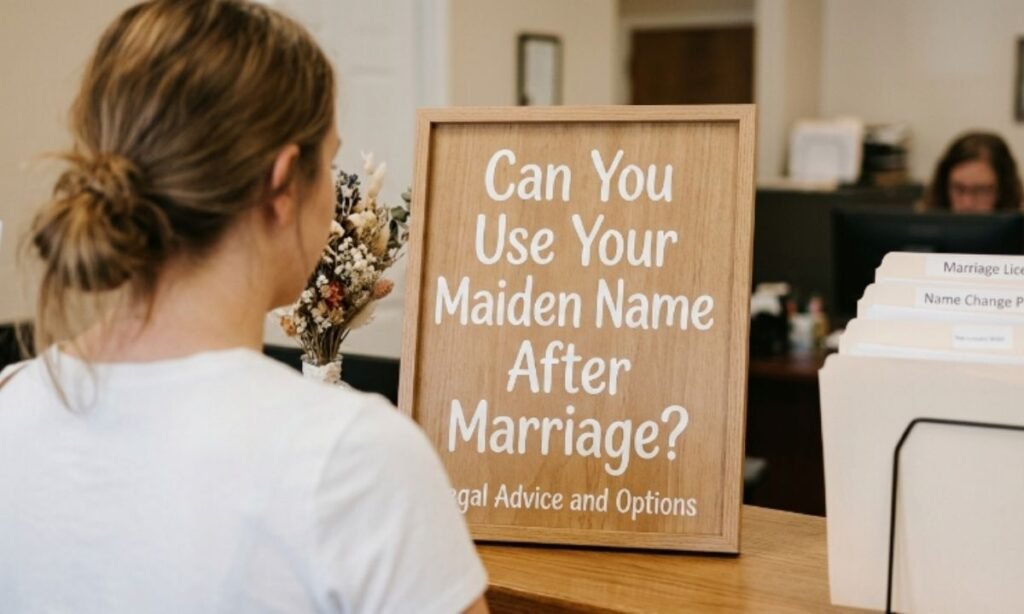
Yes. In most countries, including the U.S., UK, Canada, and Australia, there is no legal requirement for a woman to change her name after marriage. Keeping your maiden name is completely valid and increasingly common.
Here’s how women typically handle this:
- Keep it entirely No legal changes made; you continue using your maiden name on all documents.
- Use it professionally, married name legally : Some women keep their maiden name for their career or public identity while using their married name on legal and personal documents.
- Add it as a middle name : Your maiden name replaces or joins your existing middle name, while your last name becomes your spouse’s surname.
- Hyphenate both names : Combine your maiden and married names with a hyphen.
If you choose to keep your maiden name, you generally don’t need to file any paperwork — your marriage certificate doesn’t force a name change. However, if you initially changed your name and want to switch back later, that typically requires a formal legal name-change process, which varies by state or country.
How to Find Someone’s Maiden Name
Whether you’re researching family history, reconnecting with an old friend, or building a family tree, tracking down someone’s maiden name can take a bit of detective work. Here are some effective methods:
- Marriage certificates and records : These almost always list the bride’s maiden name and are available through county clerk offices or state vital records departments.
- Birth certificates of children : A mother’s maiden name is frequently recorded on her children’s birth certificates.
- Obituaries : Obituaries often mention a woman’s maiden name, especially when listing surviving family members.
- Genealogy websites : Platforms like Ancestry, FamilySearch, and MyHeritage compile historical records that often include maiden names.
- Social media: Many people list their maiden name in parentheses on Facebook or LinkedIn (e.g., “Jane Smith (Miller)”).
- School yearbooks and alumni records : Useful for tracking someone’s name before they married.
- Census records : Historical census data sometimes lists maiden names, particularly for older generations.
If you’re doing genealogical research, it’s often most efficient to start with the most recent generation you know and work backward through marriage and birth records.
Read More: 200+ Lord Krishna Names for Baby Boys With Meanings
Maiden Name vs. Birth Name: Are They the Same?
These two terms are closely related but not always identical.
| Term | Definition |
| Birth name | The name given to a person at birth, including first, middle, and last name |
| Maiden name | Specifically refers to the surname a woman had before marriage |
In most cases, a woman’s maiden name is her birth surname. However, there are exceptions:
- If she was adopted and her surname changed after birth, her “birth name” and “maiden name” might differ.
- If she changed her last name earlier in life for reasons unrelated to marriage (legal name change, following a parent’s remarriage, etc.), her maiden name would reflect whatever surname she held immediately before her own marriage — not necessarily her original birth name.
So while “birth name” and “maiden name” overlap for most people, they aren’t strictly interchangeable terms.
What Happens to Your Maiden Name on Legal Documents?
When you legally change your name after marriage, your maiden name doesn’t disappear — it simply becomes your “former name” or “prior legal name” on official records. Here’s what typically needs updating:
- Social Security card (U.S.) Update this first, as many other agencies verify against it.
- Driver’s license or state ID
- Passport
- Bank accounts and credit cards
- Employer records and payroll
- Insurance policies
- Voter registration
- Property titles and leases
Your maiden name will still appear on historical records like your birth certificate, old diplomas, and past tax filings these aren’t rewritten. Instead, your new legal name is used moving forward, and your maiden name effectively becomes part of your documented name history.
Many people also keep their maiden name accessible for identity verification purposes, since institutions may ask for it to confirm your identity even years after marriage.
How to Keep or Change Your Maiden Name After Divorce

Divorce brings up a new set of choices around your last name. Generally, you have three options:
- Keep your married name : Common if you’ve built a professional reputation under that name, or if you share children with the same surname and want consistency.
- Revert to your maiden name : Many women choose to do this as part of finalizing the divorce, often through a simple request added to the divorce decree.
- Choose an entirely new name : Less common, but legally possible in most jurisdictions through a formal name-change petition.
Steps to revert to your maiden name after divorce:
- Request the name change as part of your divorce proceedings (most courts allow this without extra fees).
- Once your divorce decree includes the name change, update your Social Security card first.
- Update your driver’s license, passport, and other identification.
- Notify your bank, employer, insurance providers, and any subscription services.
- Update your name on property titles, wills, and beneficiary designations if applicable.
If your divorce decree doesn’t include a name-change order, you can still request one separately through your local court, though it may involve an additional filing fee and process.
Conclusion
A maiden name is simply the surname a woman carries before marriage but as we’ve seen, the concept touches everything from personal identity and family history to legal paperwork and online security. Whether you’re planning a wedding, navigating a divorce, digging into your genealogy, or just curious about the history behind a common phrase, understanding how maiden names work gives you a clearer picture of how naming traditions have evolved and where they stand today.
There’s no universally “right” choice when it comes to keeping, changing, or blending your name it’s a personal decision that reflects your values, career, and family. What matters most is knowing your options and making the choice that fits your life.
Frequently Asked Questions
What is the simplest definition of a maiden name?
A maiden name is the surname a woman had before she got married, usually inherited from her family of origin.
Is maiden name the same as last name?
Not necessarily “last name” is a general term for a surname, while “maiden name” specifically refers to a woman’s surname before marriage.
Do all women change their last name after marriage?
No, changing your name after marriage is optional in most countries, and many women choose to keep their maiden name.
Why do forms ask for your mother’s maiden name?
It’s historically been used as a security or identity-verification question because it was assumed to be known only within the family.
Can a man have a maiden name?
Traditionally the term applies to women, but the same concept — a name held before marriage — applies to men through terms like “birth name” or “former name.”
How do I legally change my name back to my maiden name?
You typically request the change through your divorce decree or file a separate legal name-change petition, then update your ID, Social Security record, and other accounts.
Does your maiden name appear on your birth certificate?
Yes, in most cases your maiden name is the same surname listed on your birth certificate, unless you had a name change earlier in life unrelated to marriage.
Is it legal to use your maiden name professionally and married name personally?
Yes, this is a common and legal practice, especially among professionals who built a reputation under their maiden name before marriage.
